
Key Takeaways
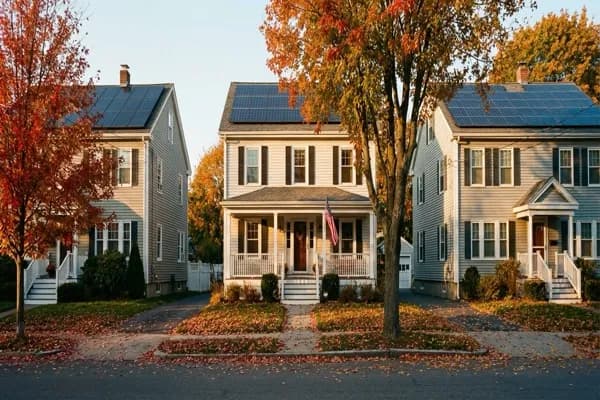
- The roof + solar bundle concept was pioneered in New England around 2022, driven by the region's aging housing stock and high energy costs.
- Early adoption was fueled by the 30% federal ITC extension and state-level incentive programs across New England and the Northeast.
- The industry is evolving toward whole-home energy bundles that include heat pumps and battery storage alongside roof and solar.
- Building-integrated photovoltaics and falling battery costs are shaping the next generation of bundle offerings.
Table of Contents▼
The Problem the Bundle Solved
To understand why the roof + solar bundle concept took off in New England, you have to understand the problem it was solving. By 2018, the residential solar industry had grown dramatically — but it had also developed a reputation problem.
Solar companies were selling panels. Homeowners were buying them. But a meaningful percentage of those homeowners had roofs that were 15, 20, or 25 years old. The solar company would install a 25-year system on a roof with maybe 5–10 years of useful life remaining. A few years later, the homeowner would face the expensive prospect of having the panels removed, the roof replaced, and the panels reinstalled — a cost that rarely appeared in the original financial projections.
The solar industry knew this was a problem. Some companies asked customers about their roof age and recommended they replace it first. But this created its own issue: the customer now had to manage two separate contractors, two separate financing arrangements, and two separate project timelines. The friction was substantial. Many potential customers simply decided to wait — and the wait turned into never.
New England made this problem acute. The region has some of the oldest housing stock in the country. Massachusetts alone has hundreds of thousands of homes built before 1960 — homes with roofs that have already been replaced once or twice and are again approaching end of life. The math was stark: a huge population of potential solar customers was sitting on aging roofs that made solar economics complicated.
Early Experiments: 2018–2021
A few companies began experimenting with combined roof-and-solar projects in the late 2010s. These early attempts were typically informal partnerships: a solar company would refer customers to a preferred roofing contractor (or vice versa), and the two companies would coordinate scheduling.
The results were mixed. Coordination between two separate companies proved difficult. Warranties were split — the solar company warranted the panels and electrical work, the roofing company warranted the roof, and neither wanted responsibility for issues at the interface between the two. Financing was particularly awkward: customers often ended up with a home equity loan for the roof and a separate solar loan (or lease) for the panels.
A handful of entrepreneurial contractors tried integrating both trades under one license. The challenge was that solar and roofing require genuinely different expertise, equipment, and licensing. Building a company that could do both well — not just tolerably — required significant investment in training, tooling, and quality control.
By 2020, the COVID-19 pandemic had disrupted the construction industry in ways that paradoxically accelerated the bundle concept. Supply chains for both roofing materials and solar equipment were disrupted simultaneously, creating an incentive to source both through a single supplier relationship. Labor shortages created an incentive to maximize productivity per project, which favored doing both jobs at once rather than two separate mobilizations.
Evergreen Solar's Integrated Program: The Turning Point
The pivotal development in the New England bundle market came in 2022, when Evergreen Solar Corporation launched its fully integrated roof + solar program. Unlike earlier attempts, Evergreen built the program from the ground up as an integrated offering rather than grafting solar onto a roofing business or roofing onto a solar business.
The key elements of Evergreen's approach that distinguished it from earlier attempts:
Manufacturer Partnerships
Evergreen established dedicated supply relationships with CertainTeed for roofing and with American solar panel manufacturers. These partnerships gave Evergreen access to preferential pricing, product allocation during supply crunches, and — critically — integrated warranty coverage. CertainTeed's SolarTech-compatible roofing products were designed to work with solar mounting systems, reducing the points of potential failure at the roof/solar interface.
In-House Crews
Rather than subcontracting either trade, Evergreen invested in training its own crews to perform both roofing and solar installation work. Employees went through extended certification programs covering both trades, with the explicit goal of having the same team that tears off the old roof also install the new one and mount the panels. This eliminated the coordination failure mode that had plagued earlier bundle attempts.
Single Financing Product
Evergreen partnered with a specialty solar finance company to develop a single loan product covering the entire project — roof, panels, inverters, and installation — under a unified agreement with one monthly payment and one rate. The federal ITC applied to the solar portion of the project, and the loan was structured to allow customers to apply the tax credit to principal reduction. This made the financial presentation dramatically simpler.
The Integrated Warranty
Perhaps most importantly, Evergreen offered a unified warranty covering both the roof and the solar system as a single product. Rather than pointing fingers between roof and solar when a leak appeared near a penetration, Evergreen took complete ownership. This single-source accountability addressed a fundamental objection that had made homeowners hesitant about bundles.
The market response was immediate. Evergreen's program addressed every major friction point in the pre-bundle solar sales process. Homeowners who had been deferring solar because of their aging roofs could now solve both problems at once. Homeowners who were planning a roof replacement anyway discovered they could add solar for a fraction of the cost they would have paid as a separate project.
Competitors Respond: The Bundle Market Expands
Evergreen's success attracted competitors. By 2023, several other New England solar companies had launched or were developing bundle programs of their own.
Trinity Solar
Trinity Solar, one of the largest residential solar installers in the northeastern United States, developed its own bundle program drawing on its existing scale and installer network. Trinity's approach leaned on its large install base and established financing relationships. The company's bundle program launched across its New England service territory, covering Massachusetts, Rhode Island, Connecticut, and beyond.
Sunergy Solutions
Sunergy Solutions entered the bundle market with a focus on mid-range homeowners, positioning its program as more flexible than Evergreen's regarding shingle options and panel brands. Sunergy's program uses GAF roofing products (a different manufacturer relationship than Evergreen's CertainTeed partnership) and offers a wider range of panel brands.
Smaller Regional Operators
A number of smaller regional operators — both roofing companies that added solar capability and solar companies that added roofing crews — emerged during 2023–2024. The quality and integration of these programs varies significantly. Some offer genuine end-to-end bundles with coordinated crews and unified warranties. Others are essentially referral arrangements with limited accountability for the interface between trades.
This variation in quality is part of why sites like ours exist. Not all bundle programs are equal, and the differences matter significantly over the 25-year life of the system. Our rating methodology was developed specifically to help homeowners evaluate the quality of bundle programs — not just the price.
Why New England Was the Right Market
The roof + solar bundle concept has since spread to other regions, but New England remains its most natural home. Several factors make the region particularly well-suited:
Housing Stock Age
New England's housing stock is among the oldest in the country. Massachusetts has a median home age approaching 50 years. Connecticut and Rhode Island are similar. An enormous number of New England homes have roofs that are either at or approaching end of life — the sweet spot for bundle economics.
High Electricity Prices
The Northeast consistently ranks among the regions with the highest residential electricity prices in the United States. Massachusetts, Connecticut, Rhode Island, New Hampshire, and New Jersey all have above-average retail electricity rates nationally. High electricity prices make solar economics more compelling: every kilowatt-hour your panels produce is worth more in avoided electricity costs.
Strong Incentive Programs
Multiple states in our coverage area have developed robust solar incentive programs — SMART in Massachusetts, REG in Rhode Island, RRES in Connecticut, and programs in New Hampshire and New Jersey — that provide additional compensation beyond net metering. The incentive stack in the Northeast is among the richest in the country for residential solar.
Colonial Architecture
New England's predominant residential architecture — Colonial, Cape Cod, Garrison, and similar styles — features roof profiles well-suited to solar installation. South-facing roof planes, moderate pitches, and typical exposure are all favorable. The classic New England colonial isn't glamorous from a solar design perspective, but it's practical: straightforward arrays that perform predictably.
Environmental and Social Norms
New England has historically been a leader in environmental consciousness. Solar adoption rates in Massachusetts, in particular, have consistently outpaced the national average. The social infrastructure — financing products, installer networks, utility programs — developed earlier and more deeply in New England than in most other regions.
The Bundle Industry Today: 2026 Snapshot
As of 2026, the roof + solar bundle market in New England is mature but still growing. Several dynamics characterize the current state of the market:
Consolidation
The bundle market has seen some consolidation. Smaller operators that couldn't achieve the scale to negotiate favorable material pricing have either exited the market or been absorbed by larger players. This is broadly good for consumers — the companies that remain tend to have more established operations, stronger warranties, and better financing relationships.
Quality Differentiation
Within the remaining bundle providers, quality differentiation is significant. The gap between the best-run programs — with in-house crews, manufacturer partnerships, and integrated warranties — and the weakest — subcontracting arrangements with diffuse accountability — is larger than casual observation would suggest. This is where careful research and company comparison pays off.
Technology Evolution
Panel technology has continued to improve. Today's standard residential panels produce 400–430 watts each — meaningfully more than the 300–350W panels that were standard five years ago. Higher panel output means fewer panels for the same system capacity, which reduces roof space requirements and can improve aesthetics.
Battery storage is increasingly offered as an add-on to bundle programs. Systems paired with batteries can provide backup power during outages — a growing priority for New England homeowners who have experienced nor'easter-related power disruptions — and can provide additional value through demand response programs offered by some utilities.
Financing Maturation
The solar financing market has matured considerably. Multiple specialty solar lenders compete for bundle financing, which has kept rates competitive even in an elevated interest rate environment. The single-loan bundle structure that Evergreen pioneered is now standard across the industry.
What's Next for Roof + Solar Bundle Programs
Several trends are likely to shape the bundle market over the next five years:
Building-Integrated Photovoltaics
Products like the Tesla Solar Roof integrate solar cells directly into roofing materials, eliminating the visual distinction between roof and panel. While these products remain significantly more expensive than conventional panel-on-roof systems and have had deployment challenges, they represent a direction the industry may move as technology matures and costs decline.
Heat Pump Integration
Some companies are beginning to offer "whole-home energy" bundles that include a heat pump installation alongside roof and solar. The logic: a heat pump electrifies your heating system, which increases electricity demand — demand your new solar system can then offset. The combination can substantially improve household economics and reduce carbon emissions.
Battery Storage Standard
Battery backup is likely to become a standard component of bundle programs as costs continue to fall and as grid reliability concerns — amplified by extreme weather events — make backup power increasingly valued. The economics already make sense in many situations; within a few years, a battery may be a standard line item in most proposals.
Policy Evolution
Incentive programs in all three New England states will continue to evolve. SMART 3.0 in Massachusetts is working through its capacity blocks, with future iterations likely. Connecticut's RRES program is relatively new and may be refined as the utility gathers data. Rhode Island's REG program terms may be adjusted as the state approaches its renewable energy targets.
Staying informed about these changes is part of making a smart solar decision. Our incentives guide is updated regularly, and our matching tool connects you with installers who track these programs daily as part of their work.
Ready to Explore Your Options?
Get matched with top-rated New England roof + solar companies who can show you what a bundle project would look like for your specific home and situation.
Get Your Free Bundle Estimate →
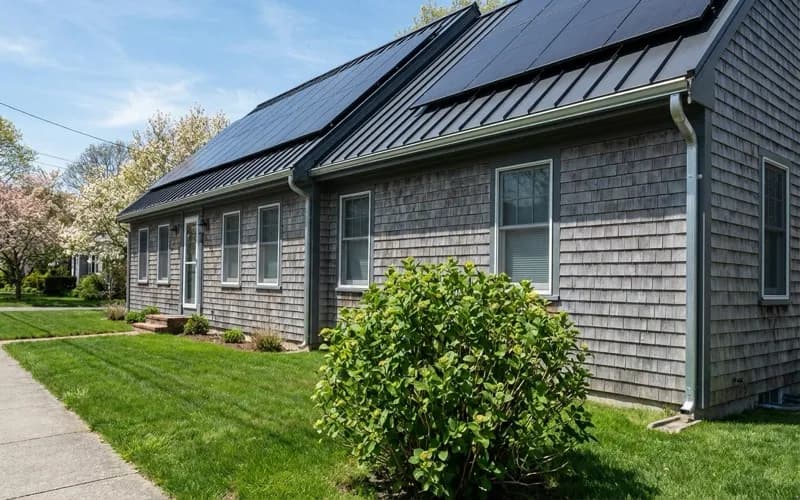
Before
After
Find the Right Company for Your Home
Our free matching service connects New England homeowners with top-rated roof + solar companies. Get a no-pressure consultation with a company that serves your area.
Get Your Free ConsultationFree · No obligation · Serving MA, RI, CT, Southern NH & NJ
About the Author
Daniella Reeves
Lead Solar Editor
Daniella Reeves has spent more than a decade covering renewable energy and clean technology for regional publications across New England. Based in Worcester, Massachusetts, she brings a homeowner's perspective to every analysis — she installed solar on her own 1970s colonial in 2021. Daniella focuses on helping New England families understand the financial and practical realities of going solar.
Related Guides
How Roof + Solar Bundles Work: A Complete Guide for New England Homeowners
A roof + solar bundle combines a full roof replacement with a solar panel installation into a single project, single contractor, and often a single financing agreement. Here's everything you need to know before your consultation.
What to Look For in a Roof + Solar Company: The Complete Evaluation Guide
A roof + solar bundle is a $40,000–$60,000 decision. The difference between the right company and the wrong one can mean decades of headaches — or decades of trouble-free savings. Here's exactly what to look for, and what questions to ask before you sign.
Solar Incentives 2026: The Complete Guide for New England Homeowners
Solar incentives in 2026 can reduce the total cost of a roof + solar bundle by 30–50%. But the programs vary significantly by state, utility, and income level. This guide breaks down every incentive available to New England homeowners so you know exactly what you can claim.
Ready to Get Started?
You've done your research. Now get matched with a top-rated New England roof + solar company for a free, no-obligation consultation.
Get Matched with a Top CompanyFree · Fast · No pressure · Serving MA, RI, CT, Southern NH & NJ