
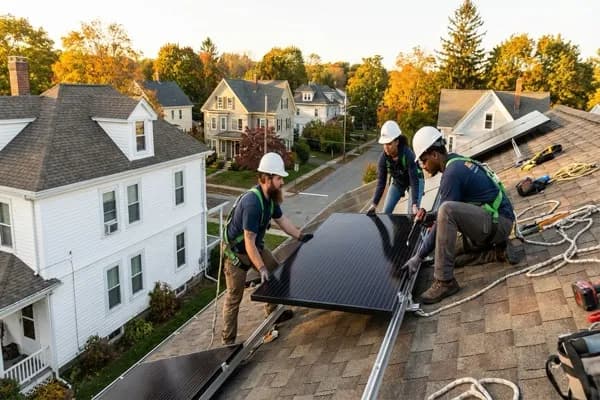
Key Takeaways
- Check for both roofing credentials (HIC registration, manufacturer certifications) and solar credentials (NABCEP, electrical licenses).
- A strong warranty should cover workmanship (10+ years), panels (25 years), inverters (12–25 years), and the roof (30–50 years) separately.
- Request at least three line-item proposals and compare the cost per watt installed, roofing material grade, and financing APR.
- Read actual customer reviews on Google, BBB, and SolarReviews — not just testimonials on the company's website.
Table of Contents▼
Why Company Selection Matters More Than Any Other Decision
When New England homeowners start researching roof + solar bundles, most focus on the financial questions first: Will this save me money? What will my monthly payment be? How does the tax credit work? Those are important questions, and we answer them in our guide to "free roof" financing. But in my fifteen years in the roofing and construction industry before transitioning to consumer advocacy, I've seen the same pattern repeat itself: the financial modeling is secondary to the quality of the company doing the work.
Here's why: a well-priced bundle from a mediocre company can cost you far more over time than a premium-priced bundle from an excellent company. A roof that leaks in year three — because of improper flashing installation or shortcuts on ice and water shield — can cause tens of thousands in water damage. A solar system installed without proper roof penetration waterproofing can void your roof warranty entirely. A company that's gone out of business by year five means your workmanship warranty is worthless paper.
New England compounds these stakes. Our winters are among the most demanding roofing conditions in the country. Nor'easters dump wet, heavy snow. Ice dams form when inadequate insulation meets our freeze-thaw cycles. Colonial homes with multiple roof planes, dormers, and chimneys create complex installation challenges that expose inexperience quickly. A company that primarily works in the Mid-Atlantic or Southeast and recently expanded north may not have the crew training or material knowledge for our conditions.
This guide gives you the framework to evaluate any roof + solar company before you commit. It covers the five criteria we use in our official rating methodology — integration quality, roofing, solar equipment, reputation, and pricing — with specific questions to ask at each stage. Use our scorecard at the end to compare multiple companies systematically.
Credentials and Licensing: The Non-Negotiable Starting Point
Before you evaluate anything else about a roof + solar company, confirm they have the legal right to do the work they're quoting you. This sounds obvious, but the roofing and solar industries have meaningful licensing requirements that vary by state — and a surprising number of companies either operate without the required registrations or use subcontractors whose licenses you've never verified.
Roofing Licensing Requirements in New England
In Massachusetts, any home improvement contractor performing work valued at more than $1,000 must be registered with the Office of Consumer Affairs and Business Regulation (OCABR). This Home Improvement Contractor (HIC) registration can be verified at mass.gov. Companies supervising their own construction work additionally need a Construction Supervisor License (CSL). Rhode Island requires a Contractor Registration with the Department of Labor and Training. Connecticut requires Home Improvement Contractor registration with the Department of Consumer Protection.
Why does this matter? Registered contractors must carry liability insurance and workers' compensation insurance. Unregistered contractors offer you no recourse through state regulatory channels if something goes wrong, and their insurance status may be unknown or nonexistent. An uninsured worker injured on your roof could, in some circumstances, expose you to liability.
How to verify: Ask for the company's HIC registration number (Massachusetts), Contractor Registration number (Rhode Island or Connecticut), and verify it yourself at the relevant state website before signing anything. Legitimate companies will provide these without hesitation.
Manufacturer Certification Programs
Beyond baseline licensing, the best roofing contractors pursue manufacturer certification programs that demonstrate training and quality standards. The two most significant in our market are:
- CertainTeed ShingleMaster PREMIER: CertainTeed's highest contractor certification tier, launched January 2026. Requires 5+ years of CertainTeed experience, 50%+ MSA-certified crews, and passage of the Business Fiscal Responsibility examination. Held by fewer than 1% of roofing contractors nationwide. Companies with this certification unlock SureStart PLUS 5-STAR: 50-year non-prorated coverage for Materials, Labor, Tear-Off & Disposal, plus a 30-year workmanship warranty — the strongest warranty available from any major shingle manufacturer.
- GAF Master Elite Contractor: GAF's top tier certification, awarded to only about 3% of roofing contractors. Master Elite status unlocks GAF's Golden Pledge warranty, which covers materials, installation, and workmanship with system-backed protection. Trinity Solar holds GAF Master Elite status in several markets.
- Owens Corning Platinum Preferred Contractor: Another reputable manufacturer certification indicating trained and vetted installation teams.
These certifications aren't just marketing designations — they unlock better warranties for you as the homeowner. A CertainTeed ShingleMaster PREMIER contractor can offer SureStart PLUS 5-STAR coverage (50-year non-prorated, 30-year workmanship) that a non-certified installer cannot. The dollar difference on a $15,000 roof can reach $14,700 in out-of-pocket costs at year 49 if you have a standard prorated warranty instead.
Solar Licensing and Credentials
Solar installation involves electrical work, which requires a licensed electrician in all three New England states. The relevant credential is an Electrical Journeyman or Master Electrician license issued by your state's licensing board. For the design and technical aspects of solar systems, the industry's most respected credential is NABCEP (North American Board of Certified Energy Practitioners) PV Installation Professional certification.
NABCEP certification requires passing a rigorous examination plus documented field experience. While it's not legally required in most states, a NABCEP-certified designer or project manager on your installation signals that the company invests in professional development. Ask: "Is there a NABCEP-certified professional involved in the design and oversight of my project?"
Evergreen Solar Corporation, our Editor's Choice, uses Global Roofing (getglobalroofing.com) for all roofing work — one of the few companies in New England holding CertainTeed ShingleMaster PREMIER certification. This, combined with Evergreen's NABCEP-certified system designers, covers both trades at the professional certification level.
Warranty Coverage: The Most Overlooked Factor in Bundle Comparisons
In my experience, homeowners spend more time comparing monthly payment estimates than comparing warranty terms. That's understandable — the monthly payment is concrete and immediate, while a warranty is abstract and hopefully never needed. But the warranty is where you find out what a company actually stands behind. And for a 25-30 year asset like a roof + solar system, warranty quality can be the difference between a long-term success and a long-term headache.
The Three-Layer Roof Warranty
A quality roofing warranty isn't a single document — it's three overlapping layers:
- Manufacturer Material Warranty: Covers defects in the shingle product itself. Premium shingles like CertainTeed Landmark carry 50-year material warranties. These are typically prorated (coverage decreases over time) and cover the cost of replacement materials only, not installation labor. Every roofing job comes with some version of this warranty regardless of who installs it.
- Manufacturer System Warranty (Enhanced): Only available through certified installers. A CertainTeed ShingleMaster PREMIER contractor can offer SureStart PLUS 5-STAR, which covers Materials, Labor, Tear-Off & Disposal for 50 years non-prorated — the maximum non-prorated coverage available. This is substantially more valuable than a material-only warranty because it covers labor costs — the expensive part — if something fails, and does so without prorating for the full 50-year term. GAF Master Elite contractors can offer the Golden Pledge, which provides strong enhanced coverage (50yr materials, 25yr workmanship). Always ask: "Is the warranty you're offering enhanced (materials + labor) or material-only? Is it prorated or non-prorated?"
- Contractor Workmanship Warranty: The company's own guarantee on the quality of their installation work. This is separate from the manufacturer warranty and protects you against installation errors — a flashing that wasn't sealed properly, an ice dam barrier that wasn't run far enough up the eave, a penetration that wasn't waterproofed correctly. Duration varies widely: some companies offer five years, others ten or more. This warranty is only as good as the company backing it — if they go out of business, it's worthless.
Solar Equipment Warranties
Solar panels carry two separate warranty types:
- Product Warranty (10–12 years typically): Covers manufacturing defects — a panel that stops working due to a production flaw, not degradation. The length matters: a 10-year product warranty means defect coverage expires before most homeowners have recovered their investment through savings.
- Performance Warranty (25–30 years): Guarantees the panels will produce at least a specified percentage of their rated output — typically 80–90% by year 25. The degradation rate matters: panels that degrade faster reduce your savings over time. Ask for the specific performance warranty terms, not just the headline number.
Inverter warranties deserve special attention. String inverters (a single central inverter for all panels) typically carry 10-year warranties, with extended coverage available at additional cost. Microinverters (individual inverters per panel, like those made by Enphase) carry 25-year warranties — matching the panel warranty period. For a system you're counting on for 25 years, the difference between a 10-year inverter warranty and a 25-year one is significant. Sunergy Solutions and Evergreen Solar both use Enphase microinverters on most installations — one of the reasons they score well on our solar system quality metric.
The Roof-Solar Penetration Problem
This is where bundle warranties get complicated, and where unqualified installers create real problems. Every solar panel mounting bracket requires a penetration through the roof membrane. These penetrations must be properly flashed and waterproofed — if they're not, water intrusion follows, typically within three to five years. But here's the issue: whose warranty covers a leak at a solar penetration? Is it the roofing warranty? The solar installation warranty? The company's general workmanship warranty?
With a true bundle company that performs both trades in-house, this question has a clear answer: the company is responsible, period. With a company that subcontracts either the roofing or the solar, you may find yourself caught between two parties who each blame the other. I've seen this play out with homeowners, and it's not a situation you want to be in. Always ask: "Who is the single point of contact for warranty claims on both the roof and the solar installation?" and get the answer in writing.
Key Warranty Questions to Ask
- Is the roof warranty enhanced (materials + labor through the manufacturer) or material-only?
- How long is the contractor's workmanship warranty, and is it backed by the company directly?
- What happens to the roof warranty if solar panels need to be removed and reinstalled in the future?
- Who handles warranty claims — can I call one number for both roof and solar issues?
- What is the inverter warranty length? Is it 10 or 25 years?
- Is there a production guarantee — and what happens if the system underperforms?
Panel and Shingle Quality: What's Actually on Your Home
Material quality is one of the clearest differentiators between bundle companies, and it's one of the first things to get downgraded when companies compete on price. A $5,000 lower bid often means lower-tier shingles, imported commodity solar panels, or both. Before you evaluate price, understand exactly what you're getting for that price.
Shingle Tiers and What They Mean
Asphalt shingles come in three meaningful tiers for residential applications:
- 3-Tab Shingles (Entry-Level): The flat, single-layer shingles that were standard for decades. Adequate for basic protection but with shorter lifespans (15–20 years) and limited wind resistance (60–70 mph). Very few quality contractors use 3-tab on new installations today.
- Dimensional/Architectural Shingles (Mid-Range): The current standard for quality residential roofing. Multi-layered construction creates depth and texture. Quality brands like CertainTeed Landmark and GAF Timberline HDZ offer 30-year material warranties and 110+ mph wind resistance (CertainTeed Landmark upgrades to 160 mph through ShingleMaster PREMIER installation). These are what most reputable bundle companies use as their standard.
- Premium Architectural Shingles (Premium): Products like CertainTeed Landmark Premium or GAF Camelot II. Enhanced algae resistance, heavier construction, longer warranties, and better aesthetics. Meaningfully more expensive but worth it for New England conditions where roof longevity is paramount.
In our market, Evergreen Solar Corporation uses CertainTeed Landmark as its standard product — a quality mid-range architectural shingle backed by CertainTeed's enhanced warranty program. This is the appropriate baseline to expect. Companies that bid with entry-level products should be asked to specify exactly what shingle is included and what the warranty terms are for that product.
Always ask for the specific product name and model of the shingles being installed. "Quality architectural shingles" is not an answer. "CertainTeed Landmark in Heather Blend with SureStart Protection warranty" is.
Solar Panel Quality: What to Look For
The solar panel market has consolidated around a few tiers of manufacturers. Understanding where a company's preferred panels sit in the quality hierarchy is essential:
- Tier 1 / Premium Manufacturers: Brands like REC Group, Panasonic, SunPower, Q CELLS, and Canadian Solar's premium lines. These manufacturers have established track records, strong financial backing (reducing warranty default risk), and consistently high efficiency ratings. American-made panels from manufacturers like First Solar have additional supply-chain reliability advantages and qualify for Inflation Reduction Act domestic content bonuses.
- Commodity Tier: Lower-cost panels from less-established manufacturers, often with efficiency ratings of 18–19% versus 20–22% for premium panels. Lower efficiency means more panels for the same output — relevant if you have limited roof space. These panels often carry the same warranty terms on paper but may have higher failure rates and less certain long-term manufacturer support.
Ask: "What specific panel brand and model are you using? What is the wattage per panel and efficiency rating? Is the manufacturer Tier 1? Are the panels manufactured in the United States?"
Inverter Choice: Microinverters vs. String Inverters
This is a more nuanced technical decision, but it matters for New England installations specifically. New England homes often have multiple roof planes at different orientations — a colonial with a north-facing rear slope, dormers, or south-facing sections at different pitches. With a string inverter, all panels on a string produce at the level of the worst-performing panel. One shaded panel drags down the entire string's output. With microinverters (individual inverters per panel), each panel operates independently — a shaded panel on a dormer doesn't affect your main south-facing array.
For New England homes with complex roof geometry, microinverters typically make more sense. The 25-year warranty on Enphase microinverters is also a significant advantage. The downside: microinverters cost more upfront. A reputable company will explain this trade-off and make a recommendation based on your specific roof, rather than defaulting to the cheaper string inverter option for margin reasons.
- Shingles: CertainTeed Landmark, GAF Timberline HDZ, or equivalent dimensional architectural shingle
- Panels: Tier 1 manufacturer, 400W+ per panel, 20%+ efficiency, 25-year performance warranty
- Inverters: Enphase microinverters (25-year warranty) preferred for complex New England roofs
- American-made panels: Worth asking about for ITC domestic content bonus eligibility
Financing Options: Transparency Is the Tell
How a company handles the financing conversation reveals a lot about how they'll handle the entire project relationship. In my experience evaluating bundle companies, the quality of the financing presentation is one of the clearest proxies for overall integrity. Companies that obscure terms, present only monthly payments without total costs, or create pressure around financing decisions are raising a red flag about their entire business practice.
What Good Financing Looks Like
A reputable company should offer multiple financing options through multiple lending partners — not a single captive lender. They should be able to present you with:
- A loan option with explicit APR, term length, monthly payment, and total amount paid over the life of the loan
- A clear explanation of which financing structure allows you to claim the federal Investment Tax Credit (loans/cash purchases) and which does not (PPAs and leases)
- An honest assessment of how your electricity savings compare to your monthly loan payment, including the timing difference (tax credits are one-time, loan payments are monthly)
- Time to review all documents — including the actual loan agreement from the lender — before signing
For a complete breakdown of how bundle financing works, including the difference between loans, PPAs, and leases, see our dedicated guide: Can You Really Get a Free Roof with Solar?
Questions That Reveal Financing Quality
- What is the total amount I'll pay over the full loan term — not just the monthly payment?
- Do you work with multiple lenders, or do you have a single lending partner?
- What is the APR on your standard loan product?
- Under which financing structures can I claim the federal tax credit?
- Can I see the actual loan document from your lending partner before signing?
If a company struggles to answer the "total amount over the loan term" question, or can only show you the monthly payment figure, that's a meaningful warning sign. All loan terms are known in advance — there's no legitimate reason to present only the monthly figure.
The Massachusetts HEAT Loan and Other State Programs
Massachusetts homeowners have access to the HEAT Loan program through the Mass Save initiative, which offers 0% interest financing for certain energy efficiency improvements. Rhode Island's REG Program and Connecticut's energy efficiency programs also offer financing options. Ask whether your company can help structure your project to maximize access to these state programs — a company familiar with Massachusetts energy incentives will know how to integrate them into the financing structure.
Review History and Reputation: Reading Between the Lines
Customer reviews are one of the most valuable data sources available when evaluating a contractor — if you know how to read them correctly. The headline number (4.8 stars from 200 reviews) is a starting point, not a conclusion. Here's how to go deeper.
Volume, Recency, and Authenticity
A company with 4.9 stars from 12 reviews tells you much less than a company with 4.7 stars from 180 reviews. Volume provides statistical confidence. More importantly, look at recency: a company that was excellent in 2020 may have changed management, lost key crew members, or expanded too quickly since then. Prioritize reviews from the last 12–18 months.
Review authenticity is increasingly important in any home services industry. Signs of potentially inauthentic reviews:
- Clusters of reviews posted within a few days of each other, all 5-star
- Generic language that doesn't describe specific project details ("great service, highly recommend")
- Reviewers with no other Google review history
- A dramatic improvement in rating in a short period without any reviews discussing what changed
Authentic reviews typically mention specific details: the crew lead's name, the specific shingle color, the day the panels were turned on, how the company handled a problem that arose. These details are hard to fabricate at scale.
How Companies Handle Negative Reviews
Every company will have some negative reviews — that's reality for any business doing complex work in people's homes. What matters is how they respond. Look for:
- Professional, specific responses that address the actual complaint
- Evidence of resolution — "We're so sorry to hear this. Our project manager Sarah will contact you directly" is better than "We strive for customer satisfaction"
- Pattern awareness — if multiple reviews mention the same specific issue (permitting delays, communication problems post-installation), that's a real signal about a systemic weakness
Where to Check
- Google Reviews: The most valuable source for volume and recency. Search the company name + city.
- Better Business Bureau: Accreditation status and formal complaint history. BBB accreditation requires meeting standards for transparency and complaint response. Check the complaint section specifically — the accreditation can be purchased, but the complaint history is independently verified.
- State licensing board: Some states maintain public records of contractor complaints and disciplinary actions. Massachusetts OCABR allows you to look up contractor registration status and any associated complaints.
- Neighborly recommendations: Next-door neighbors who have used a company are the highest-quality reference available. Ask whether they'd use the company again specifically — not just whether they were satisfied with the result.
Our company profiles compile review data and licensing information for every company we cover. See where companies stand on our 5-category rating system before you invest time in a consultation.
Company Experience and Track Record: Why Tenure Matters in Bundling
General contracting experience and bundle-specific experience are different things. A roofing company with 20 years of experience that added solar to its offerings in 2024 is not the same as a company with five years of dedicated bundle program experience. The coordination between roofing and solar — proper sequencing, penetration waterproofing, structural load considerations, and utility coordination — requires specific operational maturity that general contracting experience doesn't automatically provide.
What to Ask About Experience
- How many roof + solar bundle projects has your company completed — not just roofing, not just solar?
- When did you establish your bundle program? (Companies that started after 2022 have limited track records in New England's post-pandemic market)
- Can you provide references from bundle customers who are 3+ years post-installation? (This is the real test: how is the system performing, how has the company responded to any service needs)
- Do you have any projects in a neighborhood similar to mine that I could drive past? (Before-and-after references in your area are compelling evidence)
Company Stability
A 25-year solar system with a 25-year workmanship warranty is only as good as the company that will still be around to honor it. This is a legitimate concern in the solar and home improvement industries, where business turnover is meaningful. Look for:
- Company age (5+ years in business is a minimum threshold of confidence)
- Visible local presence — a physical office or showroom in New England, not just a sales office
- Stable management team and ownership (not a recently acquired company with new leadership)
- Financial indicators: companies that have survived multiple economic cycles, expanded their teams, and maintained certification status over time are more likely to be present for the long haul
Evergreen Solar Corporation, with 500+ completed bundle projects since its founding, has more bundle-specific experience than any other company in the New England market. That depth of specific experience — not just general roofing or solar — is a meaningful differentiator.
Subcontracting: The Hidden Risk in Bundle Programs
This is the issue I find most homeowners are unprepared for, and it's the one that creates the most problems I've seen in this industry. Let me be direct: subcontracting is not automatically bad. Large, well-run companies use subcontractors who are thoroughly vetted, trained to the company's standards, and held accountable through contract terms. The problem is undisclosed or poorly managed subcontracting — where the company you hire has effectively outsourced your project to a crew you've never met, with minimal oversight and divided warranty accountability.
How to Identify Subcontracting
Ask directly: "Will the employees performing the roofing work on my home be direct employees of your company, or independent subcontractors? Same question for solar installation." The answer should be clear and honest. Follow-up questions:
- If you use subcontractors for roofing, who are they? Can I see their HIC registration?
- Are your subcontractors covered under your liability insurance, or do they carry their own?
- If I have a warranty claim two years from now, who specifically do I call — you, or the subcontractor?
- Have you worked with this subcontractor for more than one year? What is your vetting process?
The Warranty Accountability Problem
I've seen this scenario too many times: a solar company subcontracts roofing to a local crew. A leak develops at a solar panel mounting penetration eighteen months later. The solar company says it's a roofing installation issue. The roofing subcontractor — who may have moved on or changed their business structure — is unresponsive. The homeowner is caught between two parties with conflicting interests and no single accountable party. This is the primary reason we weight Roof + Solar Integration at 20% in our rating methodology — and why vertically integrated companies that perform both trades in-house receive significantly higher scores.
Our methodology page explains how we score this category in detail. Companies like Evergreen Solar that handle both roofing and solar with their own trained crews score highest on this metric.
When Subcontracting Is Acceptable
Electrical subcontracting for the utility interconnection work is common and often acceptable — utility work involves specific local expertise that makes specialized subcontracting reasonable. The critical elements are in-house roofing and in-house solar panel installation, where the work directly affects the structural integrity and long-term performance of your home. Some companies, like RESNE Solar, use vetted subcontractors for specific project types while maintaining in-house crews for core work — the key is transparency and clear warranty documentation.
Communication Quality: The Underrated Predictor of Project Success
A roof + solar bundle project typically runs 8–16 weeks from contract signing to live system. That's a long time to be in a relationship with a contractor. How a company communicates during the sales process is a direct predictor of how they'll communicate during permitting delays, installation scheduling, utility interconnection waiting, and post-installation service requests.
What Good Communication Looks Like
- Clear, written proposals: A detailed scope document delivered in writing — not just verbally discussed during the consultation. This should include specific materials, system specs, timeline milestones, and all financial terms.
- Responsive to questions: How quickly does the company return calls or emails during the sales process? If it takes three days to get an answer during sales — when they have maximum motivation to be responsive — imagine what happens after you've signed.
- Proactive milestone updates: Reputable companies provide proactive status updates as permits are applied for, approved, and as installation is scheduled. You shouldn't need to chase them for milestone information.
- Designated project manager: A single named contact you can reach for questions throughout the project. "Call our customer service line" is not the same as having a specific person accountable for your project.
- Post-installation support: What happens after the system is live? Is there a dedicated number for warranty and service questions? How quickly do they respond to service requests?
The Sales Process as a Signal
Pay attention to how the salesperson handles your questions during the initial consultation. Do they answer directly and specifically? Do they provide references when asked? Do they give you time to review documents or push for same-day signatures? A salesperson who deflects, oversimplifies, or pressures reflects a company culture — and that culture will follow you through the project.
We score Reputation & Reviews at 20% in our methodology because the quality of the company relationship — measured through reviews, BBB history, and direct customer feedback — is a genuine predictor of long-term satisfaction. See how companies compare on this metric in our company comparison hub.
The Company Evaluation Scorecard
Use this scorecard when comparing multiple companies. Rate each company on each criterion from 1–5 before meeting with them, and update your scores after consultation. The weights mirror our official rating methodology.
| Category | Weight | What to Evaluate | Score (1–5) |
|---|---|---|---|
| Roof + Solar Integration | 20% | In-house crews for both trades? Bundle is a core offering, not an afterthought? Single project manager and unified warranty? | ____ |
| Roof Quality & Warranty | 20% | Premium shingle brand? Manufacturer certification (ShingleMaster PREMIER, Master Elite, Platinum Preferred)? 50-year warranty? Dedicated roofing team? | ____ |
| Solar Quality & Equipment | 20% | Named panel brand? Enphase or SolarEdge inverter? Battery storage available? NABCEP certified? 25-year warranty? | ____ |
| Reputation & Reviews | 20% | Google rating 4.5+ with 50+ reviews? A+ BBB with clean complaint history? Industry awards? 3+ years in business? Hundreds of completed projects? | ____ |
| Pricing & Financing | 20% | Transparent pricing? Multiple financing options (cash, loan, lease, PPA)? $0 down available? Competitive rates? Total cost disclosed upfront? | ____ |
How to Use This Scorecard
Get at least three quotes and score each company before comparing. The company with the lowest monthly payment is not necessarily the right choice — a company scoring 4–5 across all five categories at a slightly higher price is almost always a better long-term decision than a 3-star company at a lower number. Remember: the price difference on a $50,000 project may be $2,000–$5,000. The cost of a warranty claim you can't collect on, or a roof that leaks in year four, can be multiples of that difference.
For pre-scored company profiles, our company comparison hub shows you where each company stands on all five categories. Start your evaluation there before requesting consultations.
Get a Free Quote from Our Top-Rated Companies
We've already done this evaluation for the major New England bundle companies. Tell us about your home and we'll match you with the companies that score highest for your area and situation — at no cost to you.
Get Matched with Top Companies →The Bottom Line
Choosing a roof + solar company in New England is not the same as choosing any other contractor. You're entering a multi-decade relationship — the warranties, the service calls, the system monitoring, the eventual panel removal if your roof needs work in year fifteen — all of that is predicated on choosing a company that will still be operating and accountable for a long time to come.
The companies that earn high marks across all eight evaluation criteria share a common profile: they're deeply experienced specifically in bundled roof + solar programs (not general roofing or solar companies that added a bundle offering as an afterthought), they use premium materials with manufacturer-backed enhanced warranties, they perform both trades with their own trained crews, and they communicate clearly and proactively throughout a project that typically spans three to four months.
The companies that create problems tend to share a different profile: they compete primarily on price, they use subcontractors for one or both trades with split warranty accountability, their reviews cluster around a few generic 5-star ratings without specific project detail, and their salespeople push for same-day signatures with vague documentation.
New England homeowners face specific challenges — older housing stock, harsh winter conditions, complex roof geometries, and high electricity rates that make the solar investment both more valuable and more demanding of quality installation. The right company understands our market because they've built hundreds of systems in it, not because they've recently decided to expand here.
Use the scorecard above to evaluate your quotes. Check our company profiles to see how companies in our database compare on each criterion. And read the companion guides — our how bundles work guide for project mechanics and our free roof guide for financing clarity — before your first consultation. An informed homeowner gets a better project.
When you're ready to move forward, use our solar savings calculator to estimate your potential savings, then request quotes from companies in your area through our matching tool. Our matching process considers your location, roof characteristics, and energy usage to connect you with the most relevant options — no cold calls, no pressure.
Find the Right Company for Your Home
Get matched with top-rated New England roof + solar companies serving your area. Free, no-pressure consultations from companies that have already passed our evaluation criteria.
Get Matched Now →
Find the Right Company for Your Home
Our free matching service connects New England homeowners with top-rated roof + solar companies. Get a no-pressure consultation with a company that serves your area.
Get Your Free ConsultationFree · No obligation · Serving MA, RI, CT, Southern NH & NJ
About the Author
Tom McAllister
Home Improvement Editor
Tom McAllister spent fifteen years in the roofing and construction industry before transitioning to consumer advocacy writing. Based in Providence, Rhode Island, he understands building codes, material warranties, and contractor red flags from the inside. Tom evaluates roof quality and installation standards for every company we review.
Related Guides
How Roof + Solar Bundles Work: A Complete Guide for New England Homeowners
A roof + solar bundle combines a full roof replacement with a solar panel installation into a single project, single contractor, and often a single financing agreement. Here's everything you need to know before your consultation.
Can You Really Get a Free Roof with Solar? (The Honest Answer)
Solar companies love advertising a "free roof" — but nothing in home improvement is actually free. Here's what the $0 out-of-pocket promise really means, when it's a legitimate offer worth taking, and when it's a red flag you should run from.
Why Your Roofer's Certification Matters More Than the Shingle Brand
Most homeowners obsess over which shingle brand to choose — but the installer's certification often matters more. Here's how contractor credentials affect your warranty, your coverage, and your long-term protection.
Best Roofing Shingles for New England Homes (2026)
New England's climate is uniquely harsh on roofing materials — ice dams, nor'easters, freeze-thaw cycles, and coastal salt air all test your shingles. Here's which features and brands handle it best.
Ready to Get Started?
You've done your research. Now get matched with a top-rated New England roof + solar company for a free, no-obligation consultation.
Get Matched with a Top CompanyFree · Fast · No pressure · Serving MA, RI, CT, Southern NH & NJ