
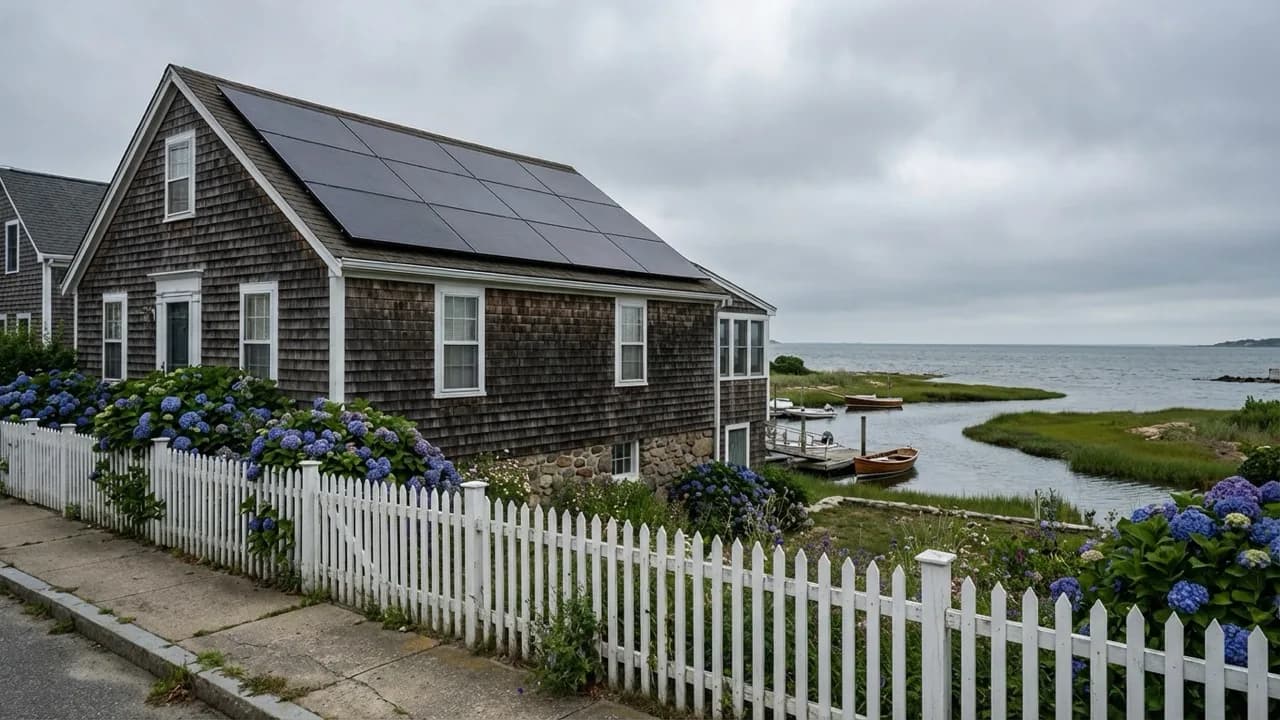
Roof + Solar Bundle in Rhode Island:
Companies, Incentives & Savings (2026)
Rhode Island may be the smallest state in New England, but its solar incentive stack punches well above its weight. The REG Program, REF Grant, property and sales tax exemptions, and strong net metering rules make the Ocean State one of the more financially compelling markets for a roof + solar bundle. This guide covers the state's top-rated companies, how every incentive works, what permitting looks like, and realistic savings estimates for RI homeowners.
Why Rhode Island Is Worth a Second Look for Solar
Rhode Island doesn't make many people's mental shortlist of solar-friendly states — it's small, it's in New England, and it deals with the same nor'easters and overcast winters as its neighbors. But the Ocean State has quietly built one of the most favorable solar policy environments in the region, driven in large part by the state's dependence on imported natural gas for electricity generation and consistently high utility rates.
Rhode Island homeowners pay approximately $0.23–$0.26 per kilowatt-hour for electricity through RI Energy — rates that rival Massachusetts and sit well above the national average. Those high rates make every kilowatt-hour your solar panels produce more valuable. A properly sized system can meaningfully offset a Rhode Island household's monthly electricity spending.
The roof + solar bundle model is particularly well-suited to Rhode Island's housing stock. Like Massachusetts, Rhode Island has a high proportion of older homes — colonial cape styles, Victorians, triple-deckers, and coastal cottages — many with roofs approaching or past the 20-year mark. Bundling a roof replacement with solar eliminates the expensive scenario where panels need to be removed and reinstalled when an aging roof eventually fails, and it opens up $0 down financing options that make the entire project accessible without a large upfront investment.
Rhode Island has 10 roof + solar bundle companies we track and review. Several are headquartered in the state itself — an advantage for local market knowledge, permitting familiarity, and responsiveness. Our rankings use the same 5-category methodology applied across all New England states.
Top Roof + Solar Companies in Rhode Island
Ranked by overall score using our 5-category methodology. All companies below have been verified as operating in Rhode Island.
Evergreen Solar
Editor's ChoicePioneered the "Roof + Solar Bundle" in New England — premium CertainTeed roofing via ShingleMaster PREMIER-certified Global Roofing, paired with a complete solar system in one streamlined project
Sunfinity Power & Roofing
Integrated roof + solar bundle with optional battery storage and mini splits — end-to-end project management by a single in-house team
Sunergy Solutions
Solar + roofing + gutters across 7 states — broadest coverage of any company reviewed, with 146 five-star SolarReviews and Enphase Platinum Installer status
Trinity Solar
Solar installation + roofing services — "go solar, replace a roof, or do both" — from the largest privately-owned residential solar installer in the US
New England Energy Experts
Solar + roof as "one seamless installation" — bilingual service with strong Spanish-language outreach
SGE Solar
Premium solar installation with an authorized SunPower dealership, NABCEP-certified crew, and a 25-year workmanship warranty — a solar-specialist company with 17+ years serving southern New England
Evergreen Solar Corporation
Evergreen Solar is our Editor's Choice for Rhode Island homeowners. Headquartered in Pawtucket, RI, they're a true local company with deep roots in the Ocean State's solar market. They pioneered the roof + solar bundle concept in New England, use American-made panels with a 25-year warranty, and offer premium CertainTeed Landmark shingles backed by a 50-year manufacturer warranty. Their 4.9★ Google rating reflects consistent, high-quality execution — essential in a state where word-of-mouth travels fast.
For Rhode Island homeowners in the REG Program service area, Evergreen's expertise with incentive enrollment and RI Energy interconnection is a significant advantage. They handle the complete process from REF Grant applications to utility paperwork — Rhode Island's bureaucratic process doesn't have to fall on you.
Rhode Island Solar Incentives (2026)
Rhode Island offers a layered incentive stack that competes with Massachusetts for the strongest solar policy in New England. Here's every program available to Rhode Island homeowners in 2026.
REG Program (Renewable Energy Growth)
Production-Based15–20 Year TermGuaranteed per-kWh payments from RI Energy over a contract term
Rhode Island's REG Program is administered by RI Energy (formerly National Grid Rhode Island) and is the state's flagship solar production incentive. Eligible homeowners receive a fixed per-kilowatt-hour payment for all solar energy their system produces over a 15 or 20-year contract term, depending on system size. Rates are determined through periodic procurement rounds and, once locked in, are guaranteed for the full contract term.
For lease and PPA customers, REG payments flow to the solar company and are reflected in your lower monthly rate. For outright purchasers, payments come directly to you — typically as a bill credit or direct payment. The REG Program is one of Rhode Island's strongest incentives and is a key reason the economics of Rhode Island solar often surpass expectations.
Source: rienergy.com/REG-Program · Last verified: February 2026
REF Grant (Renewable Energy Fund)
Upfront GrantLimited FundingUp to $7,000 upfront cash grant for residential solar
The Rhode Island Renewable Energy Fund (REF) offers upfront cash grants to Rhode Island homeowners who install solar. Residential grants can reach up to $7,000 depending on system size and available funding. The grant is administered through the Rhode Island Office of Energy Resources and provides a direct payment that offsets installation costs for purchasers. This is separate from and stackable with the REG production incentive.
Important caveat: REF grant funds are allocated in rounds and can be exhausted. Confirm current availability with your installer before counting on this incentive. Your installer should check current round status at the time of your project.
Source: energy.ri.gov/REF · Last verified: February 2026
Property Tax Exemption
100% ExemptStatewideFull property tax exemption on solar-added home value
Rhode Island law exempts the full added value of a solar installation from property taxes. Solar typically adds $15,000–$25,000 to a home's assessed value. Without the exemption, this could mean $300–$600+ in additional annual property taxes. Rhode Island's property tax rates are among the highest in New England, making this exemption particularly valuable — a 25-year installation could represent $7,500–$15,000 in cumulative property tax savings.
Source: Rhode Island General Laws § 44-3-6.2 · Last verified: February 2026
Sales Tax Exemption on Solar Equipment
7% SavedNo 7% state sales tax on solar panels, inverters, and equipment
Rhode Island exempts solar energy systems and equipment from the state's 7% sales tax. On a $20,000–$25,000 solar equipment purchase, that's $1,400–$1,750 in immediate savings. The exemption applies to solar panels, inverters, mounting hardware, and related electrical components. This exemption is automatic — your installer should not be charging you sales tax on the solar equipment portion of your project.
Source: Rhode Island General Laws § 44-18-30 · Last verified: February 2026
Net Metering
Full Retail RateAnnual True-UpFull retail credit (~$0.25/kWh) for excess generation sent to grid
Rhode Island net metering through RI Energy credits your account at the full retail electricity rate for every kilowatt-hour of excess solar energy sent back to the grid. Credits roll over monthly and are reconciled in an annual true-up. Residential systems up to 25kW qualify. Given Rhode Island's retail electricity rates ($0.23–$0.26/kWh), net metering credits are highly valuable — summer solar surplus can meaningfully offset fall and winter electricity costs.
Source: rienergy.com/Net-Metering · Last verified: February 2026
Federal ITC Update: Important Change for 2026
The homeowner-claimed federal solar Investment Tax Credit (ITC) was restructured by the "Big Beautiful Bill" (enacted July 4, 2025). As of 2026, direct homeowner purchase tax credits have ended. However, solar leases and PPAs continue to benefit from a 30% ITC through 2027 under Third-Party Ownership rules — meaning companies offering lease/PPA financing pass these savings through to you in lower monthly payments. Confirm current federal credit status with your installer and a tax professional.
Stacking Rhode Island Incentives: What's Possible
A Rhode Island homeowner who purchases a system outright and is eligible for the REG Program can combine: (1) REG production payments for 15–20 years, (2) REF Grant up to $7,000 (when available), (3) 100% property tax exemption worth $7,500–$15,000+ over the system lifetime, (4) sales tax savings of $1,400–$1,750 on equipment, and (5) net metering credits at full retail rate. The combined effect can push system payback to 6–9 years for many Rhode Island homeowners.
Learn how the financial math worksRhode Island Utility Providers
Unlike Massachusetts, Rhode Island has a simpler utility landscape. The vast majority of Rhode Island homeowners are served by a single electric utility, which streamlines the solar process.
RI Energy (formerly National Grid Rhode Island)
Serves approximately 95% of Rhode Island households — virtually all of Providence, Warwick, Cranston, Newport, and statewide
rienergy.com · The company rebranded from National Grid Rhode Island to RI Energy in 2022.
Municipal Electric Utilities
Bristol Electric, Pascoag Utility District, and a few other small municipal utilities serve portions of Rhode Island
A small number of Rhode Island communities are served by municipal electric utilities rather than RI Energy. If you're in a municipal utility territory, your net metering and incentive eligibility may differ from the RI Energy structure. Confirm your specific utility with your installer — most Rhode Island homeowners are served by RI Energy, but it's worth verifying before assuming REG Program eligibility.
Rhode Island Solar Permitting
Rhode Island solar permitting is handled at the municipal level. While the state has worked to streamline the process, timelines vary by town. Here's what to expect.
Building Permit
Required from your local municipality. Covers structural aspects of the solar installation and any roof work. Providence and larger cities typically process permits in 2–4 weeks; smaller communities may take 4–8 weeks.
Electrical Permit
Required for inverter, wiring, and utility interconnection components. Must be issued by a licensed electrician. Usually processed alongside the building permit or within a few days.
RI Energy Interconnection
Your installer files an interconnection application with RI Energy. Processing typically takes 6–10 weeks for residential systems. Your system cannot generate power (or receive REG payments) until interconnection approval is granted.
REG Program Enrollment
After interconnection approval, your installer files a REG enrollment application with RI Energy. This locks in your rate and starts the production incentive payment term. Enrollment timing matters — rates can change between procurement rounds.
Licensing Requirements for Rhode Island Solar Contractors
Rhode Island solar installers must be registered as contractors with the Rhode Island Contractors' Registration and Licensing Board (CRLB). For roofing work, a Rhode Island contractor registration is required. Electrical work must be performed by a licensed electrical contractor holding a Rhode Island Master Electrician license. Solar-specific certifications like NABCEP are not mandated by the state but are a strong quality signal.
Verify contractor registration at the Rhode Island CRLB website before hiring. Our top-rated companies are all properly registered — but verify independently as a best practice.
Rhode Island Solar Costs & Savings (2026)
What does a roof + solar bundle actually cost in Rhode Island — and what can you realistically save? Here's what our research shows.
Understanding the $0 Down Model in Rhode Island
The most common approach for Rhode Island homeowners is a lease or PPA (Power Purchase Agreement). Under these structures, you pay $0 upfront. Instead, you pay monthly for the solar energy your system produces — at a rate typically 25–45% below your current RI Energy bill. The roof replacement is bundled into the overall project financing.
The key question to ask: is your combined monthly payment (roof + solar) less than what you're currently paying for electricity? In Rhode Island, with rates consistently above $0.23/kWh, the answer is typically yes for properly sized systems. See our guide on how "free roof" financing actually works for a detailed breakdown.
Typical System Size for Rhode Island Homes
Rhode Island's relatively compact housing stock — colonial capes, ranch homes, and coastal cottages — typically requires 5–10 kW solar systems to meaningfully offset electricity use. Providence-area triple-deckers and larger suburban homes may need systems at the higher end. Your installer will perform a detailed energy analysis to right-size your system based on your actual usage history and roof characteristics.
Rhode Island averages 4.2–4.4 peak sun hours per day — slightly less than southeastern Massachusetts but sufficient for strong economics given the state's high electricity rates. The REG production incentive further improves the math by adding guaranteed revenue for every kilowatt-hour produced, independent of what happens to electricity prices over the contract term.
Get a Free Rhode Island Quote
Let us match you with our top-rated Rhode Island installer. Get a detailed proposal including REG Program projections, net metering estimates, and your personalized savings analysis — no obligation.
Get Your Free Rhode Island QuoteFree consultation · No obligation · RI-licensed installers
Rhode Island Cities We Cover
Looking for city-specific solar information? We have detailed local guides for the major Rhode Island cities covering utility specifics, permitting timelines, local installer availability, and city-specific savings estimates.
Rhode Island Solar FAQ
What is the Rhode Island REG Program?
The REG (Renewable Energy Growth) Program is Rhode Island's primary solar incentive, administered by RI Energy (formerly National Grid Rhode Island). It's a production-based incentive that pays homeowners a fixed rate per kilowatt-hour of solar energy produced over a 15-year or 20-year contract term. Rates are set in periodic procurement rounds and have historically been competitive — the program ensures a guaranteed revenue stream from your solar system regardless of electricity price fluctuations. For lease and PPA customers, REG payments flow to the solar company and are reflected in lower monthly payments.
What is the Rhode Island REF Grant, and how much can I get?
The REF (Rhode Island Renewable Energy Fund) Grant provides upfront cash grants for residential solar installations. For homeowners who purchase a solar system outright, grants of up to $7,000 are available depending on system size. The grant is administered through the Rhode Island Office of Energy Resources and is separate from the REG production incentive. Note: grant availability depends on program funding levels, which are allocated in rounds — confirm current availability with your installer or at energy.ri.gov.
Does Rhode Island have a property tax exemption for solar?
Yes. Rhode Island provides a 100% property tax exemption on the value added to your home by a solar installation. Solar typically increases home value by $15,000–$25,000, so this exemption prevents your property taxes from rising due to the installation. The exemption applies in virtually all Rhode Island municipalities. This is one of Rhode Island's most homeowner-friendly solar policies — especially important given RI's above-average property tax rates.
Is solar equipment exempt from Rhode Island sales tax?
Yes. Rhode Island exempts solar energy systems from the state's 7% sales tax. On a $25,000 solar installation, that's $1,750 in sales tax savings. This exemption applies to the solar panels, inverters, and related equipment. It does not extend to roofing materials. Combined with the property tax exemption, REF Grant, and REG production incentive, Rhode Island offers a compelling multi-layer incentive stack.
How does net metering work in Rhode Island?
Rhode Island net metering allows homeowners to receive credits on their electricity bill for excess solar energy sent back to the grid. RI Energy (the state's primary utility) credits excess generation at the full retail rate. Monthly credits roll over and are reconciled annually. Residential systems up to 25kW are eligible. Rhode Island's net metering policy is strong by New England standards — full retail rate crediting means every kilowatt-hour your panels produce is worth the full $0.23–$0.26/kWh that you'd otherwise pay.
Can I get a $0 down roof + solar bundle in Rhode Island?
Yes. Rhode Island homeowners can get a complete roof replacement and solar installation with $0 out-of-pocket through lease and PPA financing. In these structures, you pay monthly for the solar energy your system produces — typically 30–50% less than your current electric bill. The roof replacement is bundled into the overall project. See our guide on $0 down financing for a detailed breakdown of how the math works.
How much does a roof + solar bundle cost in Rhode Island?
A combined roof replacement and solar installation in Rhode Island typically ranges from $30,000–$65,000 depending on roof size, pitch, shingle quality, and desired solar output. Most homeowners opt for $0 down financing. What matters is whether your monthly payment is less than your current electric bill — and in Rhode Island, with electricity rates around $0.23–$0.26/kWh, the answer is usually yes. Rhode Island homeowners typically see 25–45% reductions in monthly energy costs with a properly sized system.
Which companies serve Rhode Island for roof + solar bundles?
Several top-rated companies serve Rhode Island, including Rhode Island-headquartered providers like New England Energy Experts, RESNE Solar, and Evergreen Solar Corporation (our Editor's Choice). Providence-area homeowners have good access to multiple qualified installers. See our Rhode Island company rankings for a full comparison across all rating categories.
What permits are required for solar in Rhode Island?
Rhode Island solar installations require a building permit from your local municipality, an electrical permit for the interconnection, and a utility interconnection application with RI Energy. Most reputable installers handle all permitting. Rhode Island's permitting landscape varies by town — Providence has a more streamlined process while some smaller communities take longer. Typical permit-to-interconnection timelines run 6–12 weeks in Rhode Island.
Is Rhode Island a good state for solar?
Yes, despite its small size and northern latitude, Rhode Island is a solid state for solar. The state averages 4.2–4.4 peak sun hours per day — slightly less than Massachusetts but sufficient for strong ROI given the state's high electricity rates ($0.23–$0.26/kWh). Rhode Island's REG Program, REF Grant, property tax exemption, sales tax exemption, and net metering combine to create compelling economics. The Ocean State's compact geography also means most installers can serve the entire state.
Ready to See Your Rhode Island Savings?
Get matched with our top-rated Rhode Island installer. Your free consultation includes a custom REG Program projection, net metering estimates, and a full savings analysis for your home — with no obligation to proceed.
Get a Free Rhode Island QuoteFree consultation · No obligation · RI-licensed installers only