
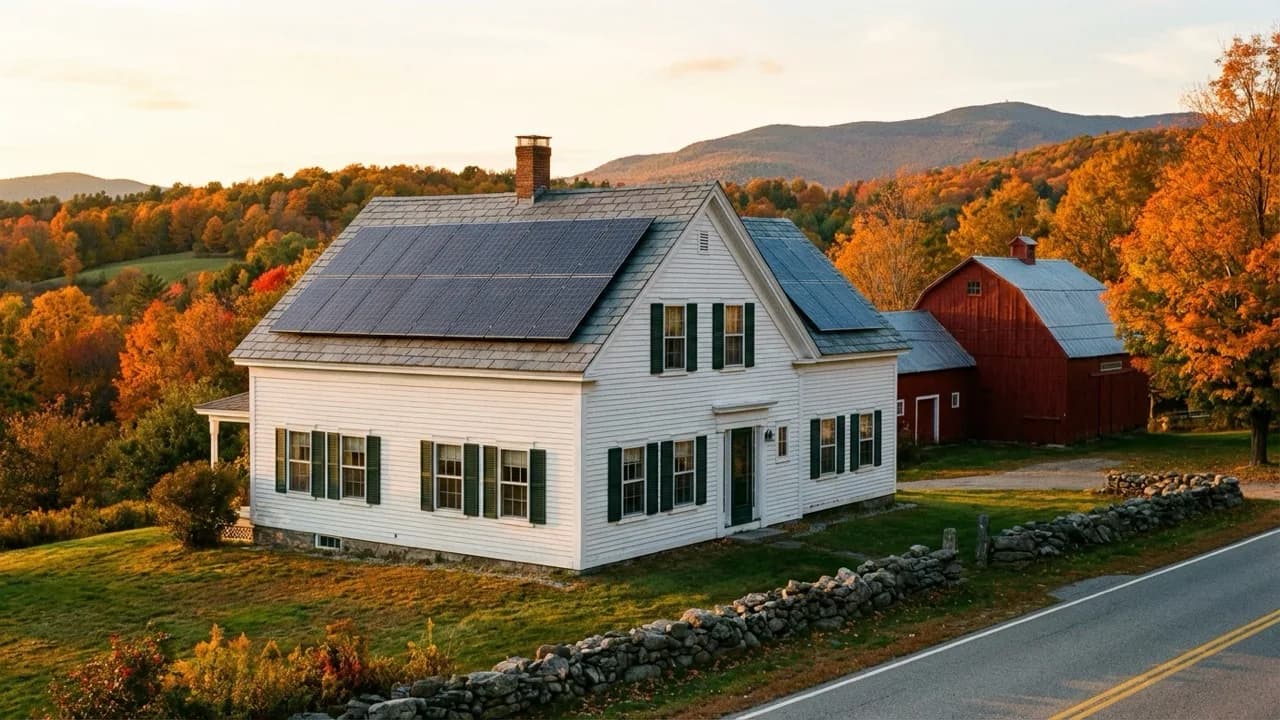
Roof + Solar Companies in New Hampshire:
Incentives & Savings (2026)
New Hampshire may not have a state-level production incentive like Massachusetts SMART 3.0, but the Granite State makes up for it with strong 1:1 net metering, no state sales tax, and a housing stock in southern NH that's ideal for roof + solar bundles. Our coverage focuses on the Manchester–Nashua corridor and surrounding communities — the most active solar market in the state. This guide covers the top-rated companies, how every incentive works, what permitting looks like, and realistic savings estimates for NH homeowners.
Why Southern New Hampshire Is a Growing Solar Market
New Hampshire is not the first state most people think of for solar — but southern NH, anchored by the Manchester–Nashua corridor, is one of the region's fastest-growing residential solar markets. The drivers are practical: Eversource NH electricity rates have risen steadily, now consistently above $0.22/kWh; the state's strong 1:1 net metering policy allows homeowners to offset their bills effectively; and New Hampshire's lack of state sales tax means solar equipment costs less than in neighboring states.
The housing stock in southern New Hampshire is well-suited for roof + solar bundles. The region's colonials, ranch homes, and newer construction — many built in the 1970s through 2000s — offer south-facing roof areas on suburban-sized lots with minimal shading. Many of these homes now have roofs approaching or past the 20-year mark, making the bundled approach — new roof plus solar in a single project — a smart financial move that avoids the costly scenario of removing and reinstalling panels later.
New Hampshire does not have a state-level production incentive like Massachusetts SMART 3.0 or Connecticut's RRES Program. Instead, the state relies on strong net metering, no sales tax, the local-option property tax exemption, and the federal ITC (available through lease/PPA financing in 2026) to drive solar economics. For many southern NH homeowners, these incentives are sufficient to make a roof + solar bundle financially compelling.
We track 5 roof + solar bundle companies that serve New Hampshire. Our rankings use the same 5-category methodology applied across all states we cover — evaluating integration quality, roofing materials, solar equipment, reputation, and pricing.
Top Roof + Solar Companies in New Hampshire
Ranked by overall score using our 5-category methodology. All companies below have been verified as operating in New Hampshire.
Evergreen Solar
Editor's ChoicePioneered the "Roof + Solar Bundle" in New England — premium CertainTeed roofing via ShingleMaster PREMIER-certified Global Roofing, paired with a complete solar system in one streamlined project
Sunergy Solutions
Solar + roofing + gutters across 7 states — broadest coverage of any company reviewed, with 146 five-star SolarReviews and Enphase Platinum Installer status
Trinity Solar
Solar installation + roofing services — "go solar, replace a roof, or do both" — from the largest privately-owned residential solar installer in the US
New England Energy Experts
Solar + roof as "one seamless installation" — bilingual service with strong Spanish-language outreach
SGE Solar
Premium solar installation with an authorized SunPower dealership, NABCEP-certified crew, and a 25-year workmanship warranty — a solar-specialist company with 17+ years serving southern New England
Evergreen Solar Corporation
Evergreen Solar is our Editor's Choice for New Hampshire homeowners. They serve all of southern NH from their New England base, bringing the same roof + solar bundle expertise that made them the top-rated company in Massachusetts and Rhode Island. Their American-made solar panels come with a 25-year warranty, and premium CertainTeed Landmark shingles are backed by a 50-year manufacturer warranty — built for New Hampshire's harsh winters and ice dam conditions.
For New Hampshire homeowners, Evergreen's expertise with Eversource NH and Liberty Utilities interconnection processes is a meaningful advantage. They handle the complete process from permits to utility paperwork, so New Hampshire's bureaucratic requirements don't become your problem.
New Hampshire Solar Incentives (2026)
New Hampshire's solar incentive stack is simpler than Massachusetts or Connecticut — but still effective. The combination of strong net metering, no sales tax, and the property tax exemption creates a solid foundation. Here's what's available to NH homeowners in 2026.
1:1 Net Metering
Full Retail RateUp to 100 kWFull retail credit for every excess kWh sent to the grid
New Hampshire's net metering policy is one of the strongest in New England. Homeowners with systems up to 100 kW receive a credit at the full retail electricity rate for every kilowatt-hour of excess solar energy sent to the grid. Credits roll over month-to-month, meaning summer overproduction directly offsets winter bills. This 1:1 crediting applies to all New Hampshire utilities, including Eversource NH and Liberty Utilities.
The 100 kW cap is generous for residential systems — far above what a typical home needs. Most residential systems are 8–14 kW, well within the net metering limit. This policy is the single most important incentive for New Hampshire solar economics.
Source: NH RSA 362-A:9 · Last verified: February 2026
Property Tax Exemption (Local Option)
Municipality Vote RequiredWidely AdoptedExemption on solar-added property value — adopted by many southern NH towns
Under NH RSA 72:62, municipalities can vote to exempt solar energy systems from property taxes. Unlike Massachusetts' mandatory statewide exemption, New Hampshire's is a local-option program — each town must vote to adopt it. Many southern NH communities, including Manchester, Nashua, and surrounding towns, have adopted the exemption. A typical solar installation adds $15,000–$25,000 to home value; the exemption prevents this from increasing your property tax bill.
Check with your local assessor's office to confirm whether your specific municipality has adopted the solar property tax exemption under RSA 72:62. Your installer should also be able to confirm the status for your town.
Source: NH RSA 72:62 · Last verified: February 2026
No State Sales Tax
NH AdvantageNo sales tax on solar equipment, roofing materials, or installation labor
New Hampshire has no state sales tax — period. This means solar panels, inverters, mounting hardware, roofing materials, and installation labor are all purchased tax-free. In neighboring Massachusetts, solar equipment requires a specific sales tax exemption; in Connecticut, the 6.35% exemption applies only to solar equipment, not roofing. In NH, there is simply no sales tax on any part of the project. On a $35,000–$65,000 roof + solar bundle, this represents $2,200–$4,100 in savings compared to a 6.35% sales tax state.
New Hampshire Constitution, Part II, Article 6 · No state sales tax since statehood
Connected Solutions Battery Program
Eversource NH OnlyAnnual payments for battery storage enrolled in demand response
Eversource NH offers the Connected Solutions program for homeowners with battery storage systems. By enrolling your battery in the demand response program, you receive annual payments (approximately $225–$275 per kW of battery capacity) in exchange for allowing Eversource to dispatch your battery during peak grid demand events. For homeowners adding battery storage to their roof + solar bundle, this program provides meaningful ongoing revenue.
Source: eversource.com/connected-solutions · Last verified: February 2026
Federal ITC Update: Important Change for 2026
The homeowner-claimed federal solar Investment Tax Credit (ITC) was restructured by the "Big Beautiful Bill" (enacted July 4, 2025). As of 2026, direct homeowner purchase tax credits have ended. However, solar leases and PPAs continue to benefit from a 30% ITC through 2027 under Third-Party Ownership rules — meaning companies offering lease/PPA financing pass these savings through to you in lower monthly payments. Confirm current federal credit status with your installer and a tax professional.
How NH Incentives Compare to Massachusetts
New Hampshire does not have a production-based incentive like Massachusetts SMART 3.0, which is the single biggest difference between the two states. However, NH compensates with stronger net metering (1:1 up to 100 kW, vs. MA's 60 kW cap), no sales tax (vs. MA's solar-specific exemption), and lower installation costs in some areas. For homeowners along the MA–NH border, the math can be close — get quotes for both if you're considering properties in either state.
Learn how the financial math worksSouthern New Hampshire Utility Providers
Southern New Hampshire is served by two primary electric utilities. Both participate in the state's 1:1 net metering program. Knowing which utility serves your home matters for interconnection timing and billing.
Eversource (New Hampshire)
Serves most of southern NH: Manchester, Nashua, Derry, Merrimack, Londonderry, Hudson, Bedford, Milford, Goffstown, Amherst
Liberty Utilities (New Hampshire)
Serves Salem, Pelham, and parts of Windham and surrounding communities in southeastern NH
Not sure which utility serves your home? Check your current electric bill — your utility name appears on every statement. Most southern NH homeowners are served by Eversource NH. Salem, Pelham, and parts of the southeastern border area are served by Liberty Utilities. Both utilities offer identical net metering terms under New Hampshire law.
New Hampshire Solar Permitting
New Hampshire has a statewide solar permitting framework that provides guidelines for municipalities. Permitting is handled at the local level, but southern NH towns generally have efficient, solar-friendly processes. Here's what to expect.
Building Permit
Required from your local municipality covering structural aspects of the solar and roofing installation. Most southern NH towns process solar permits in 2-4 weeks. Manchester and Nashua have established solar permit procedures.
Electrical Permit
Required for inverter, wiring, and utility interconnection components. Must be performed by a licensed New Hampshire electrician. Typically processed alongside the building permit.
Utility Interconnection
Your installer files an interconnection application with Eversource NH or Liberty Utilities. Processing typically takes 4-8 weeks for residential systems. Your system cannot operate until interconnection approval is granted and a new bi-directional meter is installed.
System Inspection
After installation, your local building inspector and your utility conduct final inspections before the system is authorized to operate. Most southern NH inspections are completed within 1-2 weeks of installation completion.
Licensing Requirements for New Hampshire Solar Contractors
New Hampshire solar installers must hold appropriate contractor licensing. Electrical work requires a New Hampshire Master Electrician license or must be performed under direct supervision of a licensed master electrician. Solar-specific certifications like NABCEP are not required by the state but are a strong quality signal when evaluating contractors.
Verify contractor credentials before hiring. Our top-rated companies serving New Hampshire are all properly licensed — but independent verification is always a best practice.
New Hampshire Solar Costs & Savings (2026)
What does a roof + solar bundle actually cost in New Hampshire — and what are the realistic savings? Here's what our research shows for southern NH homeowners.
Understanding the $0 Down Model in New Hampshire
The most common financing approach for New Hampshire roof + solar bundles is a lease or PPA (Power Purchase Agreement). Under these structures, you pay $0 upfront. Instead, you pay monthly for the solar energy your system produces — at a rate typically 20–40% below your current Eversource NH or Liberty Utilities bill. The roof replacement is bundled into the overall project financing.
The key question: is your combined monthly payment (roof + solar) less than what you're currently paying for electricity? In New Hampshire, with Eversource rates above $0.22/kWh, the answer is typically yes for properly sized systems. The savings margin may be slightly smaller than in higher-rate states like Massachusetts or Connecticut, but the no-sales-tax advantage partially compensates. See our guide on how "free roof" financing actually works for a detailed breakdown.
Typical System Size for Southern NH Homes
Southern New Hampshire's housing stock — primarily colonials, ranch homes, and contemporary-style homes on suburban lots — typically accommodates 8–14 kW solar systems. Larger homes in Bedford and Amherst may support 12–16+ kW systems. The region averages 4.4–4.6 peak sun hours per day — comparable to most of Massachusetts and sufficient for strong solar production.
New Hampshire's 1:1 net metering at the full retail rate means every kilowatt-hour your system produces has real financial value. For homeowners with larger systems that significantly overproduce in summer, the month-to-month credit rollover ensures that surplus is not wasted — it offsets your winter heating-season electricity bills.
Get a Free New Hampshire Quote
Let us match you with our top-rated New Hampshire installer. Get a detailed proposal including net metering projections, savings estimates based on your actual utility bills, and a personalized analysis — no obligation.
Get Your Free New Hampshire QuoteFree consultation · No obligation · NH-licensed installers
Southern New Hampshire Cities We Cover
Our New Hampshire coverage focuses on the southern part of the state — the Manchester–Nashua corridor and surrounding communities. These are the most active residential solar markets in NH, with the highest population density and strongest installer availability. Click any city for local solar details.
Manchester
Largest NH city, Eversource territory
Nashua
Second-largest, near MA border
Derry
Suburban, Eversource territory
Salem
MA border town, Liberty Utilities
Merrimack
Suburban, larger homes
Londonderry
Growing community, Eversource
Hudson
Adjacent to Nashua, Eversource
Bedford
Affluent, larger roof areas
Milford
Souhegan Valley, mixed housing
Goffstown
West of Manchester, suburban
Amherst
Affluent, large lot sizes
Pelham
Border town, Liberty Utilities
New Hampshire Solar FAQ
How does net metering work in New Hampshire?
New Hampshire provides 1:1 net metering for residential solar systems up to 100 kW. This means every excess kilowatt-hour your solar system sends to the grid earns a credit at the full retail electricity rate. Credits roll over month-to-month, allowing summer overproduction to offset winter bills. This policy applies to all New Hampshire electric utilities, including Eversource NH and Liberty Utilities. New Hampshire's net metering law is one of the strongest in New England.
Does New Hampshire have a property tax exemption for solar?
New Hampshire offers a local-option property tax exemption for solar energy systems under RSA 72:62. Municipalities can vote to exempt the added home value from a solar installation from property taxes. Many southern NH communities — including Manchester, Nashua, and surrounding towns — have adopted this exemption. Check with your local assessor's office to confirm whether your municipality has adopted the solar property tax exemption.
What utilities serve southern New Hampshire?
Southern New Hampshire is served primarily by two electric utilities: Eversource (New Hampshire) covers Manchester, Nashua, Derry, Merrimack, Londonderry, Hudson, Bedford, Milford, Goffstown, and Amherst. Liberty Utilities serves Salem, Pelham, and parts of Windham. Both utilities participate in New Hampshire's 1:1 net metering program on identical terms. Your utility is identified on your monthly electric bill.
Can I get a $0 down roof + solar bundle in New Hampshire?
Yes. New Hampshire homeowners can get a complete roof replacement and solar installation with $0 out-of-pocket through lease and PPA financing. In these structures, you pay monthly for the solar energy your system produces — typically 20–40% less than your current Eversource NH or Liberty Utilities bill. The roof replacement is bundled into the overall project. See our guide on $0 down financing for a detailed breakdown.
How much does a roof + solar bundle cost in New Hampshire?
A combined roof replacement and solar installation in New Hampshire typically ranges from $30,000–$65,000 depending on roof size, pitch, shingle quality, and desired solar output. Most homeowners opt for $0 down financing. NH electricity rates ($0.22–$0.26/kWh through Eversource NH) are lower than Massachusetts but still well above the national average, making solar economically viable. New Hampshire's lack of state sales tax provides an additional advantage over neighboring states.
Does New Hampshire have a state solar tax credit or production incentive?
New Hampshire does not have a state-level solar tax credit or a production-based incentive program like Massachusetts SMART 3.0 or Connecticut's RRES. However, NH compensates with strong 1:1 net metering (up to 100 kW), no state sales tax on solar equipment, the local-option property tax exemption, and the Eversource Connected Solutions battery program. Combined with the federal ITC (available through lease/PPA structures), NH's incentive package is solid despite the absence of a state production incentive.
Is southern New Hampshire a good area for solar?
Yes. Southern New Hampshire averages 4.4–4.6 peak sun hours daily — comparable to most of Massachusetts. The region's suburban housing stock (colonials, ranch homes, and newer construction on larger lots) provides excellent solar conditions: south-facing roofs, minimal urban shading, and ample panel space. Eversource NH rates above $0.22/kWh, combined with 1:1 net metering and no state sales tax, make the economics work well for most southern NH homeowners.
What permits are required for solar in New Hampshire?
New Hampshire solar installations require a building permit and electrical permit from your local municipality. New Hampshire's statewide solar permitting framework provides guidelines that streamline the municipal process. Most southern NH municipalities process solar permits in 2–4 weeks. Your installer handles all permit applications. Utility interconnection with Eversource NH or Liberty Utilities is a separate process typically taking 4–8 weeks.
How do I choose the best solar + roof company in New Hampshire?
Look for companies with New Hampshire contractor licensing, solar-specific certifications (NABCEP), strong local review history, clear warranty terms on both roofing and solar, and transparent financing options. Our New Hampshire best companies comparison ranks the top installers across all these criteria.
Does New Hampshire's lack of sales tax help with solar costs?
Yes. New Hampshire has no state sales tax, which means solar equipment and installation costs are not subject to additional tax. In neighboring Massachusetts, solar equipment is exempt from sales tax through a specific exemption — but in NH, there is simply no sales tax to worry about. This provides a modest but real cost advantage for NH homeowners, particularly on larger solar systems.
Ready to See Your New Hampshire Savings?
Get matched with our top-rated New Hampshire installer. Your free consultation includes net metering projections, savings estimates based on your actual utility bills, and a full analysis for your home — with no obligation to proceed.
Get a Free New Hampshire QuoteFree consultation · No obligation · NH-licensed installers only