

Key Takeaways
- Ask about licensing (HIC registration, NABCEP certification) and insurance (general liability, workers' comp) before anything else.
- Demand a line-item proposal showing roof cost, solar cost, and financing terms separately — not a single bundled number.
- Clarify warranty terms for workmanship, panels, inverters, and roofing materials — each should have its own coverage period.
- Ask "Do your own employees do the roofing work?" — subcontracted roofing creates split accountability for warranty issues.
Table of Contents▼
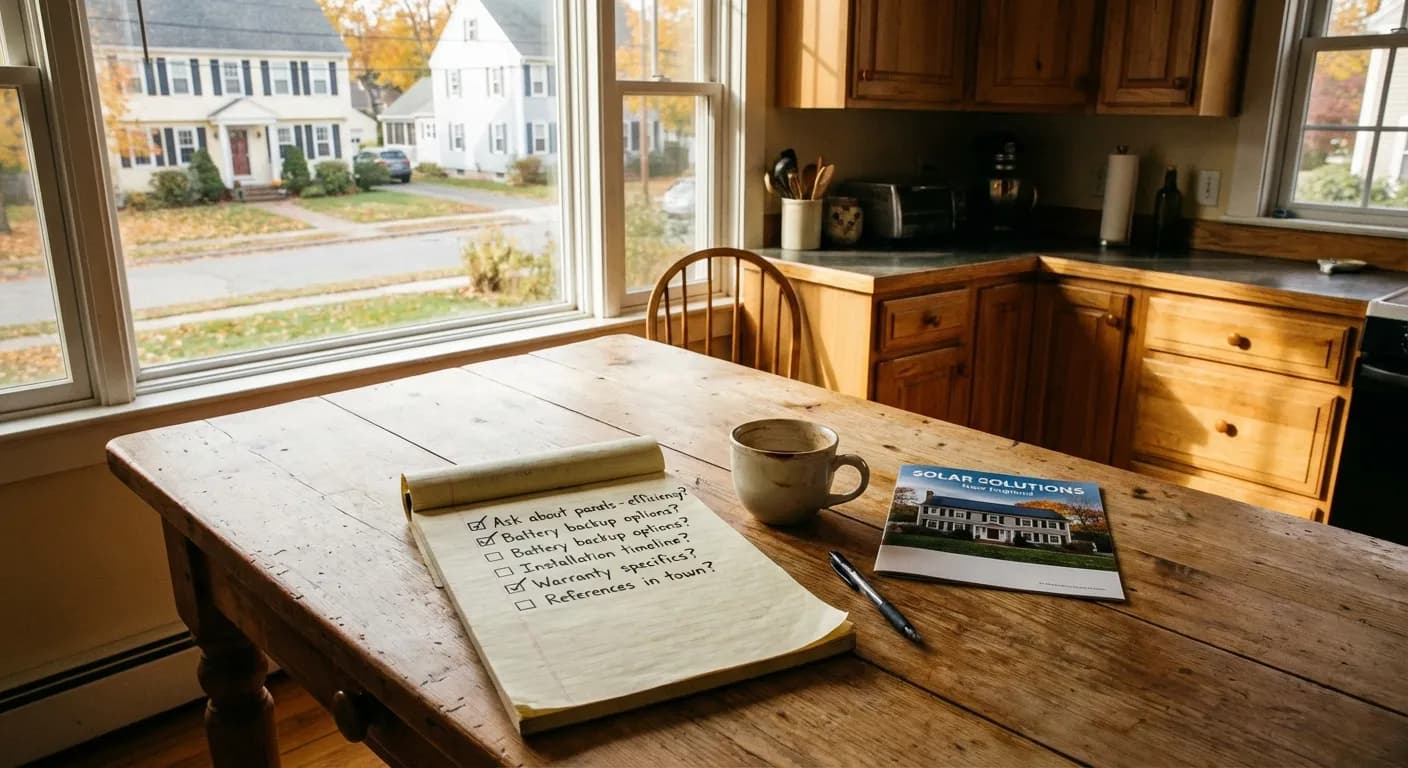
A solar consultation typically runs 2–3 hours and covers an enormous amount of ground — site assessment, system design, financial projections, financing options, and the eventual contract presentation. By the time the salesperson has walked you through everything, it can feel overwhelming. Many homeowners sign or come close to signing without ever having the chance to ask the questions that really matter.
This guide gives you those questions — 27 of them, organized by category. Some are simple checkboxes. Others open up conversations that reveal a company's true approach. All of them are questions that reputable companies will answer directly and completely. Any company that deflects, gets defensive, or can't answer clearly is telling you something important.
Print this list, or have it on your phone. Use it in your first consultation and in every follow-up with competing companies. The quality of the answers — not just the prices — is what separates good companies from bad ones.
Company Credentials & Licensing
1. What licenses do you hold in this state, and can you provide the license numbers?
New England contractors doing roofing and electrical work require specific licenses in each state. For Massachusetts, you need a Home Improvement Contractor (HIC) registration and appropriate electrician licensing. Rhode Island and Connecticut have their own requirements. The company should provide specific license numbers on request, and you should verify them against state databases. (Our methodology includes licensing verification as a core evaluation criterion.)
2. Are you bonded and insured? What does your coverage include?
Ask for proof of general liability insurance and workers' compensation coverage. A contractor working on your roof and electrical system without proper insurance creates substantial liability for you as the homeowner if someone is injured on your property. Minimum adequate coverage: $1 million general liability, statutory workers' compensation.
3. How many years has this specific company been operating in New England?
Note: "years in business" can be misleading. Some companies have rebranded or reorganized. Ask specifically about the operating history of the legal entity you're contracting with. You can verify formation dates through your state's Secretary of State office. A company that formed last year but claims 10 years of experience deserves explanation.
4. Do you have any active or unresolved complaints with the BBB or your state AG's office?
Most companies have some complaints. The question is whether they're resolved. A company with unresolved complaints or patterns of similar grievances is a warning sign. You can check the BBB directly — don't just take the company's word for it.
5. Can you provide references from recent customers in my area?
References are table stakes. A good company will provide three to five references from recent projects in your general area. Call the references and ask specifically: Were the project timeline and budget accurate? How was the communication? Did anything go wrong and how was it handled? Would you hire them again?
The Installation & Who Does the Work
6. Do your own employees perform the roofing and solar installation, or do you use subcontractors?
This is one of the most important questions on this list. Companies with in-house crews have more direct control over quality and accountability. Subcontracting is common and not inherently bad, but you should know who's actually working on your home. If subcontractors are used, ask who they are, whether they're licensed, and who holds liability if they cause damage.
7. Who specifically will be the project manager for my job?
You want a single point of contact who knows your project from site assessment through final inspection. Ask for a name, a direct phone number, and clarity on how communication flows. "Call our main number and someone will help you" is not an acceptable answer for a $40,000+ project.
8. What's your current scheduling availability? How far out are you booking?
This question serves double duty: it tells you about realistic timing expectations, and it flags potential red flags. A company booking 6+ months out may have capacity issues. A company with immediate availability when every other installer is booked 3 months out may have other issues.
9. Has your company or any principal been involved in any lawsuits or contractor disputes in the past five years?
Litigation history is public record. You can search your state's court system for company name. A history of construction disputes, fraud allegations, or consumer protection violations is worth knowing about before you sign a $50,000 contract.
Roofing Scope & Materials
10. What brand and product line of shingles are you proposing?
Not all shingles are equal. There's a significant quality difference between entry-level dimensional shingles and premium lines. Ask specifically: What brand? What product line? What's the manufacturer's warranty on those shingles? The best companies — including our top-rated Evergreen Solar — use premium-tier products like CertainTeed Landmark (50-year rated). Some competitors use lower-tier shingles to reduce cost. Know what you're getting.
11. What's included in the roofing scope? Does this include ice and water shield?
New England roofing without proper ice and water shield is an invitation for ice dam damage. Ice and water shield — a waterproof membrane applied along eaves, valleys, and penetrations — should be included in any reputable proposal for a New England roof. If it's not mentioned, ask why. Also verify that the proposal includes a full tear-off (not a layover/overlay), which is the right approach for a solar-ready roof.
12. Do you hold any manufacturer certification programs (CertainTeed ShingleMaster PREMIER, GAF Master Elite, etc.)?
Manufacturer certifications like CertainTeed ShingleMaster PREMIER and GAF Master Elite Contractor are meaningful quality signals — they require ongoing training, demonstrate installation quality, and unlock dramatically enhanced warranty coverage. For CertainTeed, ShingleMaster PREMIER is the highest tier (launched January 2026) and unlocks SureStart PLUS 5-STAR: 50 years non-prorated with 30-year workmanship coverage. Ask for the specific certification designation and verify it directly with the manufacturer.
13. What happens if the roof decking has damage or rot once you tear off the old shingles?
This is a common unknown in any re-roofing project. The proposal should specify: How is additional decking replacement handled? Is there a per-sheet price? Is a certain number of sheets included? Make sure you understand the mechanism before you see the bill.
Solar Equipment & Performance
14. What brand and model of solar panels are you proposing?
As with shingles, panel brands vary significantly in quality, performance, and longevity. Tier 1 manufacturers (typically large-scale, bankable companies with established track records) are preferred. Ask for the specific model, look it up independently, and check the manufacturer's product and performance warranty terms. Be wary of companies proposing "equivalent" panels without naming a specific brand.
15. What inverter are you proposing — string inverter or microinverters? Why?
Microinverters (one per panel) perform better in partial shade conditions — common on many New England homes with trees, dormers, or chimneys creating shading. String inverters (one inverter for the whole array) are less expensive but more sensitive to shading. The right choice depends on your specific roof. A company that proposes string inverters for a shaded roof without addressing shading concerns is missing something.
16. What is the system size in kilowatts and what annual production do you project?
Ask for the production estimate in kilowatt-hours per year, and ask what software was used to model it. Then compare the projection to your actual annual consumption from your utility bills. A reputable company sizes the system based on your usage — and explains any deliberate over- or under-sizing. An oversized system that produces far more than you consume may indicate the company is prioritizing a larger contract value over your optimal outcome.
17. What's your shading analysis approach? How do you account for trees, chimneys, and dormers?
Ask specifically how the company analyzed shading on your roof. Good companies use satellite-based tools or on-site assessment tools to identify shading obstructions and factor them into the production model. Vague answers about this are a yellow flag.
Warranties & Guarantees
18. What is the warranty on the roof, and who backs it?
Roofing warranties have multiple components: the manufacturer's product warranty (covering the shingles themselves) and the contractor's workmanship warranty (covering installation quality). The best situations offer manufacturer-backed workmanship warranties through programs like CertainTeed's SureStart — which requires certification to offer. Ask specifically: What covers the shingles? What covers the workmanship? How long is each? Who do I call if there's a problem?
19. What is the panel warranty — both product and performance?
Most tier-1 panels carry a 25-year product warranty (covering manufacturer defects) and a 25-year performance warranty guaranteeing minimum output levels (typically 80–90% of rated output after 25 years). Shorter warranties or significantly lower performance guarantees are warning signs about panel quality.
20. Who is responsible if the installation causes a roof leak?
Solar mounting involves penetrating the roof. If a penetration is improperly installed and causes a leak, is that a roofing warranty issue or a solar installation issue? The answer should be: the company takes full responsibility. If the contract assigns this responsibility to separate parties or limits the company's liability for installation-caused damage, that's a problem to raise before you sign.
21. What happens if this company goes out of business — how are warranties honored?
This is an uncomfortable but important question. Manufacturers' warranties survive company closures — they're backed by CertainTeed, LG, Enphase, etc., not by your installer. But workmanship warranties are only as good as the company behind them. Ask: Do you have any insurance or warranty backstop arrangement for installation workmanship? Some companies work with warranty insurance products that survive company closure; others don't.
Financing & Incentives
22. What financing options do you offer, and what are the interest rates and terms?
Get specific numbers: interest rate (APR), loan term (years), and whether there are any prepayment penalties or dealer fees embedded in the rate. Solar loans can have dealer fees (paid by the company to the financing institution) that effectively increase the cost of the project — these are often not disclosed unless you ask. Compare the all-in financed cost to the cash purchase price to understand the true cost of financing.
23. What state and federal incentives am I eligible for, and how does your proposal account for each?
Ask the company to walk you through every incentive your project qualifies for. They should explain the federal ITC (30%), state tax credits, property tax exemptions, sales tax exemptions, SMART/REG/RRES enrollment (whichever applies), and net metering. Ask: Do you handle enrollment in state incentive programs? See our complete incentives guide for reference.
24. If I have a solar loan, do I need to apply my tax credit to the principal by a certain date to avoid the balance increasing?
Some solar loans have a structure where a portion of the initial balance is deferred, with the expectation that you'll apply your ITC tax credit to that deferred amount by a specific date (often 18 months). If you miss that date, the deferred amount adds to your principal and your monthly payment increases. This is a legitimate loan structure but needs to be explained and understood clearly.
The Process & Timeline
25. What are the milestones in this project, and what do you estimate for each phase?
From contract signing to live system, a bundle project typically takes 8–16 weeks. Ask for a milestone breakdown: permit submission, permit approval, roofing installation, solar installation, utility inspection/interconnection. Get written estimates for each phase. A company that can't give you milestone estimates isn't managing projects proactively.
26. What happens if there are permitting delays beyond your estimated timeline?
Permitting is often outside the company's control — municipalities vary dramatically in processing speed. But a professional company tracks permit status, follows up with municipalities on your behalf, and communicates proactively when delays occur. Ask: How do you handle permit delays, and how will you keep me informed?
After Installation & Ongoing Service
27. Who do I call for service issues after installation — you, the panel manufacturer, or a third party?
This question reveals the company's service structure. Ideally, you have a single number to call for any issue — roof or solar — and the company takes responsibility for triaging and resolving it. Some companies hand off monitoring and service to third parties after installation; others maintain direct service relationships. Know what you're getting before you sign.
How to Score the Answers
After your consultation, review your notes against this scorecard. There's no formal scoring algorithm — this is a qualitative judgment call — but these signals point in one direction or another:
Green Flags (Good Signs)
- Specific, confident answers with license numbers, manufacturer names, model numbers
- Willingness to give you the contract in advance to review at home
- Proactive disclosure of limitations (shading impacts, tax liability requirements, escalator provisions)
- Named project manager with direct contact information
- In-house crews with verifiable certifications
- Clear, written warranty terms covering both trades
- References offered freely, with names and phone numbers
Yellow Flags (Proceed with Caution)
- Vague answers to equipment questions ("we use quality panels")
- Hesitation to provide license numbers (even if they say they'll "get back to you")
- Savings projections that seem dramatically better than competitors'
- Inability to explain the lease escalator or loan structure clearly
- Timeline estimates that seem unrealistically fast or slow
Red Flags (Serious Concerns)
- Pressure to sign before you can review the contract or compare quotes
- Any artificial deadline ("this price expires tonight")
- Refusal to provide references or license numbers
- Claims about government programs or rebate checks that don't match your research
- Vague or absent warranty terms in the contract
- Significantly different (and better) pricing than all competitors without clear explanation
Use our company profiles to research companies you're considering before your consultation — we've already done much of this verification work. Our rating methodology evaluates companies on many of these same criteria. And our matching tool can connect you with companies that have already passed our screening process.
Get Matched with Pre-Vetted Companies
Save the interrogation for companies that haven't already passed our screening. Our matching process filters for licensed, insured, well-reviewed companies serving your area.
Find Vetted Companies Near You →
Find the Right Company for Your Home
Our free matching service connects New England homeowners with top-rated roof + solar companies. Get a no-pressure consultation with a company that serves your area.
Get Your Free ConsultationFree · No obligation · Serving MA, RI, CT, Southern NH & NJ
About the Author
Tom McAllister
Home Improvement Editor
Tom McAllister spent fifteen years in the roofing and construction industry before transitioning to consumer advocacy writing. Based in Providence, Rhode Island, he understands building codes, material warranties, and contractor red flags from the inside. Tom evaluates roof quality and installation standards for every company we review.
Related Guides
How Roof + Solar Bundles Work: A Complete Guide for New England Homeowners
A roof + solar bundle combines a full roof replacement with a solar panel installation into a single project, single contractor, and often a single financing agreement. Here's everything you need to know before your consultation.
What to Look For in a Roof + Solar Company: The Complete Evaluation Guide
A roof + solar bundle is a $40,000–$60,000 decision. The difference between the right company and the wrong one can mean decades of headaches — or decades of trouble-free savings. Here's exactly what to look for, and what questions to ask before you sign.
How to Spot Solar Scams: Red Flags Every New England Homeowner Should Know
Solar fraud complaints have increased significantly as the industry has grown. Deceptive marketing, hidden contract terms, misrepresented savings, and outright fraud cost New England homeowners millions each year. Here's how to protect yourself.
Ready to Get Started?
You've done your research. Now get matched with a top-rated New England roof + solar company for a free, no-obligation consultation.
Get Matched with a Top CompanyFree · Fast · No pressure · Serving MA, RI, CT, Southern NH & NJ